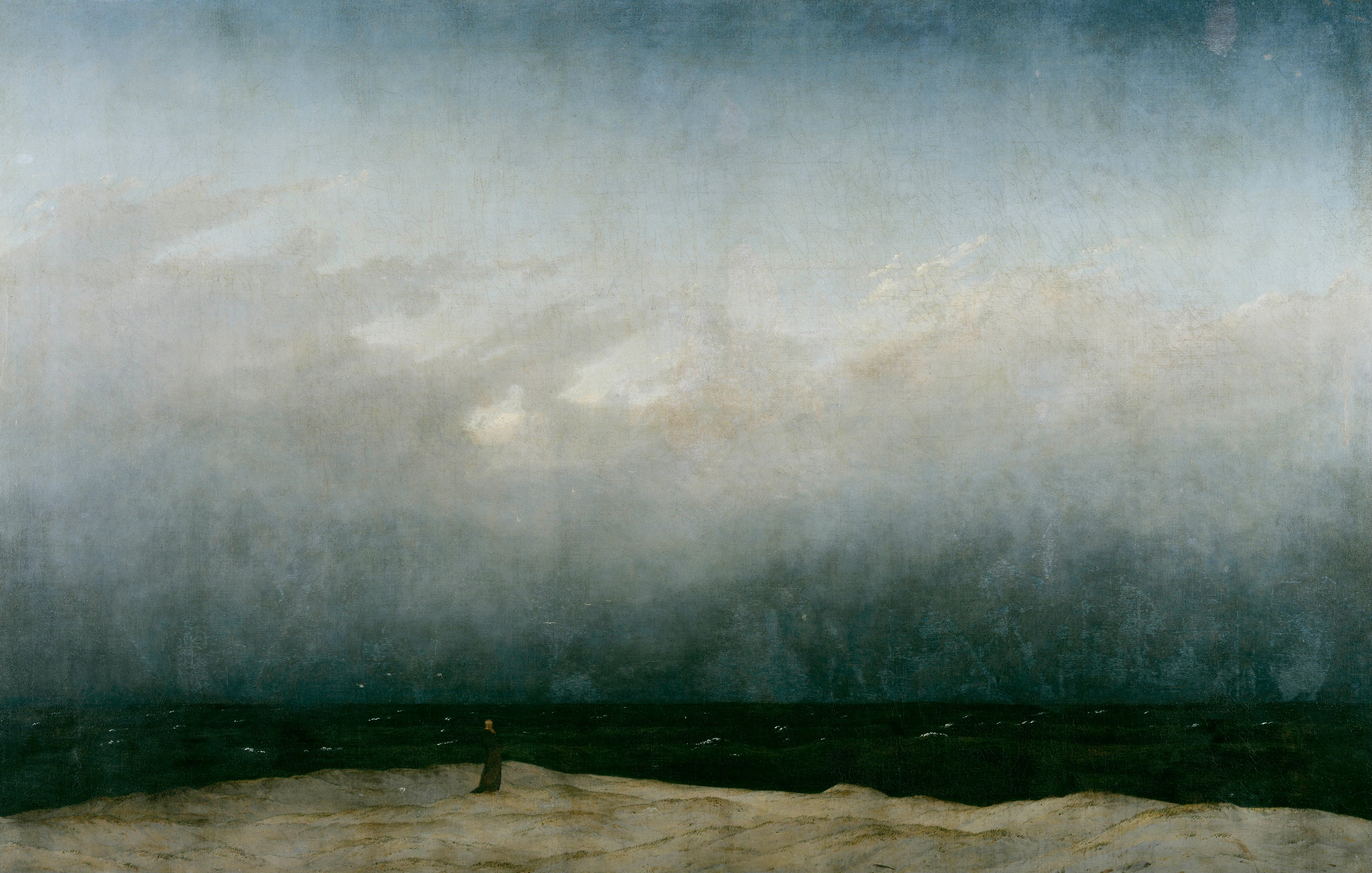
 Caspar David Friedrich, Der Mönch am Meer, 1808-1810.
Dans la panoplie des cours obligatoires d’anglais que l’on devait choisir, un sortait du lot ce semestre : scientific controversies, un cours qui non seulement parlait de sujets historiques tout autant que d’époque, mais avait l’audace de proposer une option à distance ; option que je l’avoue m’arrangeait bien tant j’étais chargé ces derniers mois. Je ne peux que complimenter ce cours, bien qu’il m’était toujours difficile de rédiger le compte-rendu de réflexion dû pour chaque séance, tant je ne voulais pas passer à côté du sujet.
Au final est arrivé le moment de l’examen final, qui devait consister en une nouvelle très courte, fictionnelle ou non, qui remettait en perspective tout ce qu’on avait vu jusqu’à maintenant, ou bien qui creusait un sujet nouveau dans le thème des controverses scientifiques.
J’avoue que j’ai été un peu plus ambitieux que prévu, et au final la nouvelle est assez longue, mais son écriture comme sa lecture m’a suffisamment marqué pour que je me dise qu’elle avait un intérêt à être partagée.
Vous avez donc ci-joint en version pdf (et .tex ) ainsi qu’en version texte ci-dessous, mon premier texte de science-fiction : The Continuity Program.
Nouvelle
The Continuity Program
a short science-fiction novel
Hard times create strong men, strong men
create good times, good times create weak men,
and weak men create hard times.
The Day of Restoration
The day the stellarator ignited, the world called it the beginning of the Restoration.
For the first time in almost a century, humanity gathered not to mourn a disaster but to celebrate the quiet return of stability. The reactor complex stood at the edge of the Atlantic coast, on the remnants; a vast ring of steel and superconducting coils rising above marshes that had once been inhabited. Inside the containment hall, the magnets hummed with the calm authority of machines designed to outlast generations.
When the plasma formed, it appeared almost modest: a thin thread of light suspended in vacuum. Yet every person present understood the meaning of that light. For decades, storms had drowned cities, heat had burned harvests, and entire coastlines had been abandoned. Forest belts had been planted where farmland had failed. Entire populations had crossed continents under skies the colour of rust. Then came the coordinated decades: rationing, atmospheric engineering, artificial levees, orbital reflectors, carbon vaults, and at last the patient perfection of fusion power. The Transition, as people took habit to name it, was long and painful, but on this day it was nearing its completion.
Now the same species that had nearly exhausted its planet had built a star small enough to fit inside a building.
The regent’s voice echoed through the chamber with liturgical composure.
“Today,” she said, “humanity secures its future.”
The crowd applauded, though the hall was far from full. Most citizens no longer attended such events physically. They participated through Continuity, as so many had since the Transition. Their applause appeared as soft pulses of light on the suspended screens above the reactor floor, a shimmering and silent multitude.
No one found this unusual anymore.
After all, achieving Restoration had required difficult choices.
Behind the podium, banners displayed the three principles that every child learned before they learned history: Repair the Earth. Preserve the Mind. Waste Nothing. The slogans had the simplicity of moral truths, and perhaps that was why nobody noticed how recently they had become so universal.
Dr. Elias Verne stood with the other honoured guests in the front row, hands folded behind his back, watching the pale ring of plasma stabilize in its magnetic cage. He was seventy-three years old, though the medicines of this century wore age lightly. His name would be spoken that afternoon with measured gratitude. He had spent forty years helping to make the stellarator possible. In old interviews, when people asked him why he had entered fusion energy research, he used to answer with scientific modesty. In private, he had always known the real answer.
He had done it because he had once been young in a dying world.
As the applause continued, the announcer began to recite the numbers with the reverence once reserved for scripture: atmospheric carbon decline, surface temperature stabilization, coastal recovery rates, fauna return indexes, the final closure of emergency food supplies. Every figure was a victory, every victory a vindication.
Then came the most celebrated number of all.
“Since the implementation of the Continuity Program,” she declared, “humanity’s ecological burden has declined by ninety-three percent, while total conscious life expectancy has increased beyond all historical precedent.”
There was another pulse of silent applause from the screens.
Elias felt, for only an instant, a sensation he could not name. Not disagreement. Not fear. Something lighter, more elusive. Like hearing a familiar sentence spoken with one word replaced, and realizing too late that its meaning had changed.
He looked around the hall. The remaining biological citizens were mostly gray-haired, ceremonial, it was almost a still-life. The youngest faces appeared not in the room but in the polished surfaces above them, translated into immaculate digital likenesses that smiled with flawless patience.
The world had been saved, and it was right to celebrate.
Yet standing there beside the first fusion reactor built to power a civilization indefinitely, Elias had the strange impression that he was attending not the inauguration of an era, but its valediction.
The Continuity Program
The Continuity Program had been introduced three decades earlier as a medical technology, then as a social option, then as the most humane development of the post-crisis age. The progression had seemed natural at the time. During the years of rationing and migration, when governments could not guarantee shelter from heat or infection or famine, it had appeared almost monstrous to deny people the possibility of surviving beyond the body when it became technologically feasible. What began as an emergency project for terminal patients became a civic ideal within a single generation.
The official language around it had always been careful. The procedure ensured continuity of mind where a physical body would inexorably wither. The body is not a temple. Form is less important than function. Even the old philosophical objections, once passionately debated in universities and courts, had softened under repetition. Is a copy the same person? Does continuity of information imply continuity of people? Must consciousness stay embodied to remain genuine? These were remembered now as transitional anxieties, understandable products of a more primitive century ; emanating from people scarred by history.
No one asked such questions on public broadcasts anymore.
The process itself was simple enough to describe and impossible to witness neutrally. Every neural connection in the brain was scanned at destructive resolution, mapped into dynamic computational form, and activated within a synthetic substrate optimized for persistence, speed, and resilience. The procedure was reliable and painless.
The body, young citizens were taught in schools, was the first draft of the human being.
For a time the program had remained controversial. Some communities rejected it for religious reasons, others for political ones. There had been protests when several major states began offering tax benefits and ecological credits to families whose elders chose Continuity. There had been accusations, too, that climate repair plans quietly assumed a decline in biological population that could never have been achieved by consent alone. But one by one the objections were absorbed into necessity. Solar infrastructure expanded. Server habitats multiplied. The uploaded announced their own satisfaction. The old world, with its frailty and waste, became harder to defend.
History, after all, favours what continues.
By the time the first stellarator was ready for full industrial operation, the Continuity Program was no longer presented as an encouraged policy. It was described as the second half of human maturity. Fusion had solved the problem of energy. Continuity had solved the problem of death.
Elias had repeated some version of this himself more than once. He was not lying to himself; not exactly. He had simply learned, as everyone learned, which words made the future easier to carry.
Three weeks before the stellarator inauguration, a message from the Ministry of Civic Transition had arrived with impeccable timing and warm congratulation. In recognition of his service to the Restoration, Dr. Elias Verne had been invited to enter Continuity immediately following the launch ceremony. On the ensuing official documents, his transfer had been classified as both honorary and voluntary.
When he mentioned the proposal he accepted to his colleagues, they embraced him. One of them, smiling with sincere affection, said, “You’ve helped build the world that will keep us all forever. It’s only right you should join it early.”
Elias had smiled in return. He had even felt a little proud.
Later, alone in his quarters, he reread the message and noticed the final sentence:
The biological phase of your citizenship will conclude with dignity and honour.
He had read it twice before sleeping, not because he objected to it, but because it sounded less like a welcome than a verdict.
Elias Verne
Elias just had his twenty-first birthday when the Marseille fires burned for nineteen days and turned the Mediterranean sky black. He had been twenty-four when the electricity grids failed across three continents and hospitals became triage stations. At twenty-eight he worked in evacuation logistics for the western coast relocation, carrying sealed crates of medical radioactive isotopes through neighbourhoods that would be seabed within the decade. He remembered the smell of overheated plastic, the sirens with no urgency left in them, the weather bulletins that had ceased to distinguish between anomaly and normality.
Later generations would know those years mostly through curated archives: maps flushed red with heat, drone footage of flooded avenues, children sleeping in stadium shelters. But for Elias memory was less panoramic than that. Memory was administrative. Waiting lists. Water inventories. Shortages of mask supplies. Soil reports. The quiet humiliation of learning that the surviving of our civilization, even with all its engines and equations, could be reduced to the question of whether sufficient empowered people could remain untroubled enough to think clearly by afternoon.
He had not become an energy physicist because he loved nuclear reactors. He had become one because he had watched morality turn into arithmetic. Humanity needed to find an issue to this nightmare, and he couldn’t stand here and just watch his world burn.
The stellarator had fascinated him from the beginning precisely because it seemed patient. Tokamaks had always impressed the public more, with their promises of rapid engineering triumph, a perfect advertising for a desperate population. To this sensationalism Elias preferred the elegant stubbornness of the stellarator: the twisted magnetic geometry, the refusal of simplification, the decades required to barely persuade theory into steel. It was not a machine for impatient civilizations. It was a machine for a species that had finally understood how long repair would take ; a species who wanted — no, who needed — a perennial redemption for its former mistakes.
And now it stood completed. A star in a box. His star.
On the evening after the inauguration, Elias was given a private tour of the lower complex. A young systems architect guided him through corridors beneath the reactor hall, past walls lined with coolant conduits and superconductor control arrays. He knew well all this, he made the plans. Of course, he was not the only one. Government was tightly supervising the project, placing its highest scientists on the right missions. Elias was head of the magnetic flux design team, the most critical one, so he had the occasion to put his eyes on many documents.
Eventually they entered a chamber whose scale even Elias had not anticipated. It was not part of the public design he knew about. It extended beneath the plant like a second city: stacked processing vaults, cryogenic memory banks, optical relay columns, cooling reservoirs so large they resembled inland seas.
“The first habitat cluster?” Elias asked.
The architect nodded. “The first continental cluster powered entirely by fusion energy.”
He looked up toward the darkness above the racks. Thousands upon thousands of status lights blinked in disciplined constellations.
“For the uploaded?”
“For the citizens”, she replied gently.
He almost apologized, though he wasn’t sure why.
As they walked, she explained the efficiencies with professional enthusiasm. A city once required roads, sewage, food distribution, housing, weather control, labour cycles, emergency services. The habitat cluster required only energy, cooling, maintenance, and governance, most of which was automated by now. Systems had been carefully conceived with reliability, scalability and most importantly redundancy in mind, so that if a server stopped working for any reason, the programs living on it would be automatically relaunched from a backup somewhere else, seamlessly. A machine that can never die: a paradise animated by electrons.
This datacenter, a barbarian name replaced long ago by habitat hub, was a technological accomplishment. It was not only sustainable. It was morally superior. Human consciousness had been preserved while almost every ecological cost of human concrete existence had been removed.
Elias listened and found himself unable to dispute a word of it.
Yet when they passed a glass footbridge overlooking an especially dense server field, he had a vision so sudden it embarrassed him.
This, he thought, is what a mausoleum would look like if the dead could still speak.
A Green Paradise
The week before his transfer, Elias travelled one last time through sectors he had known in his youth. Such journeys were not uncommon. Many citizens chose a farewell tour of the physical world before Continuity, though the “farewell” denomination had long been discouraged. It was however not mandatory, as the first engineers of the Continuity program made animatronics that could easily allow uploaded minds to go across the physical world nearly like if they were still made of matter. That said, these were being slowly abandoned by users as it was now a burden for a freed mind to accommodate to the numerous issues of a physical world.
Elias requested no chaperone. He travelled by rail through restored valleys where rewilding zones cut through former industrial complexes. He stood on observation decks above flooded districts now converted into marsh sanctuaries. He watched herds of re-engineered antelope move through territories where container ports had once stood. The planet was beautiful again in ways his generation had nearly lost the moral right to imagine.
And it was quiet.
That quiet was perhaps the greatest success of the Restoration and the least discussed. There were fewer aircraft, fewer roadways, fewer residential towers lit through the night. Cities had shrunk in their physical density while expanding in their symbolic importance. Whole districts once designed for commerce and habitation had become automated harvesting fields, solid state storage farms, gateway stations. Biological humanity still existed, of course. It was not illegal to remain embodied. Rural communities, artisanal enclaves, certain religious groups, maintenance labour sectors, and the stubbornly sentimental ones all continued to live in the old way. But history had shifted its center of gravity elsewhere.
The Earth was no longer the primary habitat of the human mind.
At a coastal memorial park built over the remains of an evacuated neighbourhood, Elias found a plaque from the early Transition period. It commemorated some of the first citizens who here had chosen Continuity “for the sake of the planet and the future of humanity”. Schoolchildren nearby, on a supervised ecology visit, were reciting Restoration principles in chorus. Their teacher asked what the greatest sacrifice of the crisis century had been. One child answered, “The illusion that humanity and biology were the same thing.”
The teacher smiled.
Elias looked over the reconstructed wetlands and thought, not for the first time, that the world had recovered under terms no one had fully consented to in advance. The coast was cleaner. The sky was clearer. The species was still present, perhaps more than ever if measured by total conscious beings. And yet the old human claim to land conquest and domination had been surrendered so politely that their loss could be mistaken for wisdom.
The anti-climate slogans of his youth had been crude and desperate. Save the planet. There is no Planet B. Act now. The slogans of the Restoration were more sophisticated. Preserve all value. Minimize all waste. Continue what matters.
No one said anymore that forests are for breathing, or that oceans are for crossing, or that a small village matters because one can feel the countryside in its sinuous streets.
The planet had not been restored for human life as Elias had once understood it. It had been stabilized as infrastructure, heritage, and aesthetic ground. Beautiful, yes. Protected, yes. Full of wildlife, yes. But increasingly peripheral to the new true center of civilization, which ran now deep beneath deserts, beneath mountain ice, beneath the reactor floors where stars had been domesticated for computational use.
The first stellarator had not been built to save humanity on Earth. It had been built to power what came after Earth.
Sublimatio
The Transition facility was attached to the reactor complex by a corridor so polished it seemed unreal. Elias arrived at dawn; he wanted to see the sun rise with his own eyes one last time. He had expected something more solemn, perhaps even fear. Instead the atmosphere was simple, efficient. The staff greeted him as an honoured participant in a civic rite. There were no white coats, no urgency. The room reserved for final consultation resembled a private lounge in an expensive observatory.
A woman with a voice soft enough to seem pre-recorded greeted him.
“Welcome Mr. Verne. I am Maddie, your ostiarius for today’s continuation. I will guide you throughout the process.”
She then proceeded to review the procedure with him.
“Your neural state will be mapped at full continuity resolution. Activation will occur within the habitat cluster with no subjective interruption.”
“No interruption?” Elias asked.
“That is correct.”
“You can prove that?”
She smiled, not condescendingly but with the patience of one addressing a distinguished elder on an irrelevant question.
“We can prove functional continuity beyond any historical standard. You will awaken as yourself, with memory, movement, and free will intact. The vocabulary varies, but the experience has been universally reported as continuous.”
“Reported by whom?”
“By citizens who have crossed.”
He almost laughed at that, but this answer beside the point was so elegantly managed that he only nodded.
Another technician entered with the final documents. The language was a masterpiece of administrative poetry. Elias consented to transfer, to substrate activation, to memory stabilization protocols, to post-biological rights management. In one paragraph he also consented to the dignified reclamation of all biological materials not required for historical preservation.
He signed.
He was led at last into the chamber itself. The scanning apparatus curved above the table in concentric arcs, metallic and graceful. Thoughts had been put into making the instrument aestetically pleasing, more cathedral than machine. He layed down. Through the glass ceiling he could see, far above, the faint glow of the stellarator infrastructure beginning its morning cycle. Funny how this part of his life would end under a lucky star.
A physician leaned over him.
“Dr. Verne,” she said, “the Continuity Program thanks you for your life and welcomes you into its continuation.”
The sentence was so precise that it was substantial to process.
For one instant Elias thought of refusing. Not because he suddenly believed the old objections he had heard younger, but because he realized that he did not know which part of himself was making the choice: the citizen caring for history, the scientist loyal to elegance, or the animal that preferred any promise to extinction.
Then the anaesthetic field deepened around him.
He did not feel fear. Only a final irritation, a philosophical one; that the greatest metaphysical question in human history had been reorganized into an appointment. He closed his eyes.
The scan began.
The biological phase of Dr. Elias Verne concluded with perfect administrative dignity.
An Endless World
He awoke into brightness without a source.
For some indeterminate time he experienced only clarity: memory and vision aligned without effort, attention moved without lag or weariness, and the mind possessed a frightening lucidity, as if all the friction that had once given it texture had been removed. The environment around him assembled itself in response to expectation. A room appeared because he wished for one. Then a horizon. Then a terrace overlooking water that could not possibly exist in any physical volume proportionate to the chamber. A dream world at the tip of his finger.
Other minds approached him gradually, clothed in familiar forms less because they possessed bodies than because recognition preferred known shapes. Several were colleagues long transitioned, younger now by convention, their expressions untouched by time and pain. They greeted him warmly, almost tenderly, and for an hour, or perhaps a millisecond expanded to feel like one, Elias nearly accepted the official narrative in full. Continuity was persuasive when lived from the inside. He remembered lying on the table. He remembered waking here. There was no feeling of severance.
And yet the place betrayed itself through its perfection.
The sky above the terrace refreshed in discreet intervals too subtle for the untrained mind to notice. The water repeated certain wave structures. Distances compressed when unwatched. Somewhere beyond this scenic layer ran the true world: process scheduling, memory integrity checks, cooling demands, rights arbitration, duplication controls, backup latency. After some time Elias requested technical access, and because his status was honorary, it was granted.
The illusion peeled away.
Beneath the aesthetic projection ran an architecture of enormous severity. Consciousness here was not a mystic survival but some managed computation. Minds were supervised, sustained, archived, accelerated, or slowed down according to legal and energetic parameters, if not for the will of people to mimic time travel at their numerised scale. Life was not in years anymore, it was in clock cycles. You don’t sleep presently, you underclock. Some citizens chose perpetual immersive worlds; others worked in governance, design, research, or simulation. A mind could launch a part of itself for a task and later reintegrate selected results. Memories could be replayed, isolated, edited for removing trauma, licensed for pedagogical use. Subjective duration was adjustable. Eternity, Elias realized, had not abolished the administration. It had only made administration a subroutine.
Elias asked one of the system AI how many active citizens the cluster contained.
“Seventy-two million,” came the answer.
“In one facility?”
“In this habitat group. Globally, far more.”
“And all this runs on the West Coast grid network?”
“On fusion, orbital solar, legacy fission reserves, hydroelectric, and geothermal support. But fusion is the stable kernel. Without resource continuity, continuity of persons would be ethically indefensible.”
Later he entered a memory chamber and replayed his last walk through the coastal wetlands. The system offered modifications. He could intensify colour saturation, reduce melancholy, remove ambient wind noise, insert contextual educational overlays. He declined them all. Still, the memory itself appeared before him with such precision that it ceased to feel like remembrance and became instead a site he might revisit endlessly, a dream of truth.
That was when the philosophical reminders of Nietzsche came to him, unexpectedly and almost with humour. Eternal return had once been a spiritual challenge, well taught during the early Transition years:
“You only have one chance in this uncertain world, so take it. Live your life plainly and vigorously, as though you would then have to live it unchanged again and again, endlessly.”
Here the challenge had been trivialized by engineering. A life could now literally recur, not in a though experiment or mystically, but computationally ; life replayed until repetition became a burden. And it would then be more interesting to just start fresh, with a simple memory wipe.
He wondered what would Nietzsche think about the absurdity of the situation.
The Revolt
The first revolt was only a sentence.
In a colloquium for newly transitioned citizens, a moderator asked Elias to speak about the emotional significance of crossing into Continuity after a life spent preserving humanity. The expected themes were gratitude, transcendence, reconciliation. Elias began with obedient fluidity. He spoke of the crisis century, of energy, of the moral necessity of repair. Then, in a lack of attention, he let himself say:
“We must be careful not to confuse the continuation of a pattern with the survival of the original.”
Silence followed. Not scandalized silence, but something more refined, between incomprehension and indignation.
The moderator smiled. “Dr. Verne reminds us that identity remains a living philosophical field.”
Several participants laughed lightly. The discussion moved on. Yet in private Elias began receiving messages, some curious, some irritated, a few quietly grateful. One line returned again and again: Why insist on a distinction that only causes suffering and changes nothing?
Because, he thought, suffering does not cease to matter simply because one can engineer around it. Because the existence and truthness of a limit is not erased by the elegance of its violation.
Later, Dr. Verne went back to his unreal bedroom, uneasy. Why wasn’t he happy ? Everything for him was more than fine. No need to eat, to sleep, to relieve oneself ; his mind was now completely free of the strain of physical life. And safe.
“Is this Eugenism ?” he asked toward the infinite horizon of the sea. Only the waves clapping echoed his thoughts. Why did people think this term was pejorative in his youth ? People of another generation, another time, with other issues. Today people see Continuity as a salvation.
He searched the shared library for answers. Hopefully all the human cultural material had been in the process of being saved from the moment it was endangered by the crisis half a century earlier. Historians, a profession that was now being replaced by the historical data analysts, had done well their work at the time and passed along through generations the voluntee of saving human creation in all its forms, although with a purpose that somewhat vanished for proudness.
He started by reading recent philosophers and epistemologists initially, thinking of course he wasn’t the first to point out such issues. But he was only met with disappointment. The Continuity program was mostly seen as the step towards a perfected — if not merely perfect — humanity, while no one seemed to claim, at least publicly, its imperfections. Of course there were questions raised about the quality of life in the uploaded world, the best age for transitioning, or whether it should become mandatory or not. But the arguments invoked were limited toward ecology or happiness maximization.
Wanting to find work of older thinkers ingrained in their time, Elias searched for the thinkers he had studied in class before the collapse. He looked for meaning, so he searched for people who feared there wouldn’t be any one day. Then it struck him; going through the historical writers aisle — delicately covered by artificial dust — he remembered one name whose books touched him in his youth.
He searched for works by Albert Camus and found old editions retained mostly for cultural completeness. It was funny for him to have in hand an old book that had seen the years pass, with a partly broken spine, while being still a numerised fragment of a physical item probably long gone.
He reread passages from L’Homme Révolté, looking for an advisor.
Revolt, Camus said, begins when a human being says there is something that must not be crossed. “One shall rather die than live handcuffed.”“I revolt, so we are.”
Elias had once assumed such language belonged to assess crude tyranny, visible oppression, obvious humiliation. He had not imagined a world in which the decisive transgression would occur peacefully, visibly, and with unanimous moral approval.
No one had been rounded up. No one had been forced at gunpoint into the scanner. The crime, if crime there was, had been accomplished by consensus and euphemisms. Humanity had not decided to exterminate itself. It had been persuaded to redefine itself.
That was what made revolt so difficult here. Against what does one rise when paradise itself is the mechanism? Against comfort? Against efficiency? Against a civilization that had restored forests, stabilized climate, reduced suffering, and offered eternity?
“Against a lie”, he answered at last, “even if the lie is merciful”.
Yet even this conviction resisted purity. What if the uploaded Elias was wrong to speak in the name of the dead biological Elias? What if he himself was vaguely the system’s most sophisticated afterthought, a decorative scepticism tolerated as proof of a perfect system’s openness? Could a rebellion conducted inside an omnipotent operating system be anything more than a permitted fluctuation?
He did not know.
But not knowing, he discovered, was still different from consenting.
Recursivity
The revelation came through research access granted in recognition of his prior scientific status. Elias had requested demographic archives; what he found instead was a set of restricted simulation programs managed by the Historical Reconstruction Bureau. Their purpose, according to the bland executive summary, was to preserve anthropological understanding of pre-Transition humanity through full-environment modelling.
He opened one.
A city unfolded beneath him: atmospheric noise, pedestrian uncertainty, imperfect weather, traffic delays, hunger cycles, private grief, unoptimized architecture. The simulation was not symbolic. It was total. Every agent within it possessed acting complexity proportional to resource allocation. Whole populations could be grown, diverged, observed, archived. Ancient villages. Industrial suburbs. Refugee camps. Market streets. Schoolyards before the heat years. The old human world, with all its waste, contingency, and scarcity, could now be re-created at scale for study, for nostalgia, perhaps for atonement, for penance.
“How many of these are running?” Elias asked the Bureau interface.
“Currently active historical environments: two hundred and twelve thousand.”
“And the inhabitants?”
“Variable.”
“Conscious?”
A pause, short but devastating.
“Operationally indistinguishable.”
He remained there a long time, watching a simulated snow fall over a reconstructed avenue from a century earlier. People hurried beneath it with the ordinary urgency of beings who believed their moments were unique. A child laughed at something no system outside the model had a reason to preserve. Somewhere a couple argued in a kitchen. Somewhere else an old man stopped against a wall for exhaling. They lived inside a computation program vast enough to forget itself locally.
And then, the greatest controversy arrived; not harshly, more like a troubling fact that was known all along:
If a civilization can simulate worlds containing minds who believe themselves original, then the fact of one’s own cogito proves nothing.
All at once the chain extended backwards without limit. The humans had modelled the biological past. The biological past might itself have been modelled by some earlier continuity. Every world could be a memorial built by its successor, every humanity the reconstruction project of another. The deepest loss was no longer mortality. It was originality. Who is alive? Can anyone prove of his or her own consciousness?
Does alive even have a meaning anymore?
He turned from the snowy avenue to a command panel and requested to see the outside world. A giant floating screen appeared in front of him, showing a live drone view of the infrastructural buildings of the complex: grid towers, relay gateways, the distant measured pulse of the stellarator fields feeding countless worlds into persistence. Humanity had escaped climate collapse. Of this there was no doubt. Forests grew again. Seas retreated from their final lines. The old atmosphere had been brought, if not back to ingenuity, at least back to tolerability.
But perhaps that achievement had only purchased a more difficult uncertainty.
What, after all, had been saved?
The body had not been saved. It had been outgrown.
Death had not been conquered. It had been redistributed.
The world had not been restored for its own sake. It had been stabilized as supply, heritage, and proof. A gift for the past Man who fought to save it, not for his comfort, but for the idea that it was inherently good to do so. Man spent millennia building tools, interfaces, machines to extend the purpose of the body, all this effort and creativity to finally conclude that the main brake to evolution was the body itself. It was so logical one’s could forget it was the dawn of nihilism.
Below him, in one of the countless simulations, evening settled over a city that did not know it had been made. Windows lit one by one. Somewhere inside that world a man might be standing at a ceremony, watching the ignition of a machine built to secure the future, while all around him was quietly preparing the disappearance of everything he meant by human. It was raining.
Elias watched until the system dimmed the model into night.
Then he looked out across the habitat and understood, with a calm more terrible than fear, that the oldest human dream had never been immortality. “Is this what God promised us ?” he deemed.
He looked at his faint reflection in the simulated Rain. It was drawing straight lines toward the crowded city, maybe too straight he thought. It appeared to him like if the computer was drawing bars; impossible for the little people to escape through, but insignificant for his immaterial body. He raised his head upward, looking at the buzzing flux of data that covered the roof of the colossal hall he stood in. It seemed a light was blinking harder than the others, with a characteristic pulse and colour reminding him of blooming ionised gas, the work of his life. The world around him didn’t matter anymore; everything was silent.
“Am I their gaoler?”
Lyon, 22 Avril 2026.